Why MBA-SLC Uses a No Return, Replacement, or Refund Policy to Keep Prices Lower
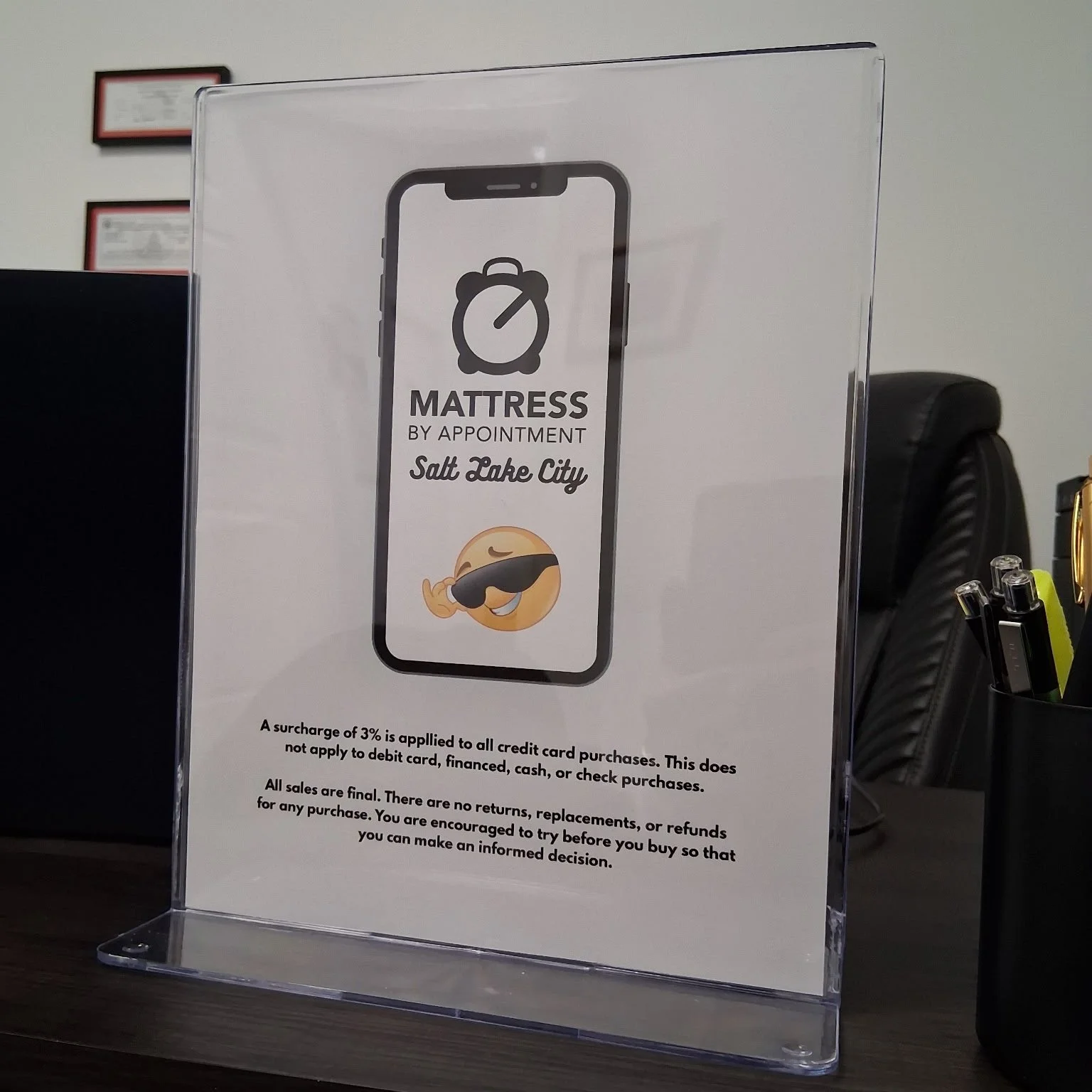
Mattress By Appointment Salt Lake City is committed to value and service. These policies are designed to make quality mattresses, foundations, and protective mattress covers accessible to the working-class of Salt Lake City. All customers are free to test their desired product at the showroom before committing to any purchase.
Lower Prices Require Lower Overhead
One of the most important parts of MBA-SLC’s business model is overhead control. That may sound like a behind-the-scenes business subject, but it has a direct effect on what customers pay. Every store has expenses. Rent, utilities, inventory, advertising, delivery coordination, payment processing, labor, taxes, merchant fees, software, insurance, and administrative work all have to be paid somehow. In many retail businesses, those costs are quietly built into the sticker price of every item.
MBA-SLC’s goal is different. The purpose of this showroom is to make excellent sleep more accessible to working people in Salt Lake City and the surrounding area. That means the business has to be careful about which costs are added to the structure and which costs are avoided. A mattress store cannot offer lower prices simply by saying it wants to. It has to be built in a way that prevents unnecessary overhead from accumulating in the first place.
That is one reason MBA-SLC uses a no return, replacement, or refund policy.
Why the Policy Exists
This policy is not meant to be unfriendly, dismissive, or difficult. It is meant to keep the business model sustainable, transparent, and affordable. It is also meant to make the buying process clearer before a purchase is made. Customers are encouraged to look carefully, ask questions, compare options, discuss comfort preferences, consider delivery needs, and make sure the mattress they choose is the one they actually want before completing the purchase.
A mattress is not like a sealed box of hardware, a shirt on a rack, or an unopened household item that can easily be placed back into inventory. Once a mattress leaves the showroom, the situation changes. Even if the mattress looks clean, even if it was only used briefly, and even if the customer handled it responsibly, the store cannot realistically treat it the same as untouched showroom inventory. Mattresses are personal-use products. Customers expect them to be clean, sanitary, and trustworthy. A returned mattress creates a serious problem: it may no longer be suitable to sell as new, but it still represents real money that the business has already spent.
“Free Returns” Are Usually Not Free
Large retailers often absorb that problem by charging higher prices across the board. They build the cost of returns into the system. When a customer returns a product, that cost does not disappear. It is spread across other customers through higher prices, restocking fees, larger markups, stricter financing terms, or more expensive operations. The “free return” is rarely free. It is usually paid for by everyone else.
MBA-SLC does not want to operate that way.
The showroom is designed around lower overhead and more direct pricing. That means keeping avoidable costs out of the business wherever possible. A return policy may sound generous on the surface, but in the mattress business it can become expensive very quickly. A returned mattress can result in lost wholesale cost, lost selling time, additional handling, transportation expenses, cleaning concerns, administrative work, damaged packaging, customer-service disputes, storage issues, and the need to replace the item with another product. Those costs eventually have to be recovered.
How Final Sales Reduce Overhead
If MBA-SLC allowed returns, replacements, or refunds as a normal part of business, the store would have to price inventory differently from the beginning. The cost of possible reversals would need to be built into every sale. In other words, even customers who carefully choose the right mattress and keep it would still be paying for the return risk created by other transactions.
That is the overhead-reducing effect of the policy.
The no return, replacement, or refund policy allows MBA-SLC to operate with fewer hidden costs. It helps prevent the business from needing a large reserve fund for reversed sales. It reduces the need for extra storage space for returned goods. It limits administrative time spent processing after-sale disputes. It avoids the sanitation and resale complications that come with personal-use products. It reduces transportation and handling waste. Most importantly, it allows the business to keep its pricing structure more direct.
Customers Should Choose Carefully Before Purchase
This does not mean MBA-SLC wants customers to rush. It means the opposite. Because sales are final, the decision should be made carefully. Customers should take the time to test the mattress, ask about firmness, compare models, think about who will be sleeping on it, consider whether they need a foundation or platform, and ask about delivery options before paying. The showroom process is intended to give customers enough information to make a confident decision before the transaction is complete.
A final-sale policy works best when the buying process is transparent. MBA-SLC aims to be clear about what the customer is purchasing, what the price is, what payment options are available, and what the policy is before the sale is completed. That is why the policy is not hidden as a surprise after the fact. It is part of the pricing model. Lower-overhead retail requires clear expectations on both sides.
Why MBA-SLC Is Different From Large Chain Stores
This is especially important because MBA-SLC is not trying to imitate the large chain-store model. Large stores often have many layers of cost: large buildings, large sales staffs, corporate departments, regional managers, expensive showrooms, national advertising campaigns, commissioned sales systems, complex return departments, and higher built-in margins. Those systems may offer certain conveniences, but customers pay for them whether they use them or not.
MBA-SLC’s structure is leaner. The showroom is smaller. The operation is local. The business model depends on reducing unnecessary cost and passing that advantage into the offer itself. A strict final-sale policy is part of that lean model. It keeps the store from needing to inflate prices to protect itself against open-ended return exposure.
Responsible Buyers Should Not Subsidize Return Risk
There is also a fairness issue. If one customer buys carefully, keeps the mattress, and uses it for years, that customer should not have to subsidize a system built around frequent reversals. In a return-heavy model, responsible buyers often pay more because the retailer has to protect itself against the cost of other customers changing their minds. MBA-SLC’s policy keeps responsibility closer to the individual transaction. The customer gets a lower-overhead buying opportunity, and the business avoids building return risk into every price.
The same general reasoning applies to replacement requests. Replacing a mattress after purchase may sound simple, but the business impact is similar to a return. A replacement can mean the store loses the original item, provides another item at additional cost, handles extra transportation or pickup issues, and spends more administrative time on one sale than the pricing model was designed to support. If a store plans for that routinely, it has to charge more from the beginning.
Refunds create an even larger issue because the business may have already paid costs that cannot be recovered. Inventory was purchased. Time was spent. Payment processing fees may have been charged. Advertising may have produced the lead. Appointment time may have been used. Delivery may have been arranged. Once those costs have occurred, refunding the full sale price can turn a completed transaction into a loss. If enough transactions work that way, a store has to raise prices to survive.
MBA-SLC would rather prevent that cycle by making the final-sale nature of the transaction clear upfront.
Better Decisions Happen Before the Sale
This also encourages a better kind of shopping experience. Instead of pressuring customers to buy quickly and then relying on returns later, MBA-SLC’s preferred approach is to help the customer make a more informed decision before purchase. The best time to solve uncertainty is before the mattress is bought, not after it has been taken home. Customers are welcome to ask direct questions about price, comfort, size, support, financing, delivery, policies, and product differences before making the decision.
Why MBA-SLC Uses a 3% Credit Card Surcharge
Another overhead-related issue is payment processing. MBA-SLC also uses a 3% credit card surcharge because credit card payments create a direct processing cost for the business. When a customer pays with a credit card, the full purchase amount does not simply arrive in the business account without expense. Payment networks, processors, and merchant-service providers charge fees for the transaction. For a small business with tight pricing, those fees matter.
A 3% credit card surcharge is not intended as a punishment for using a card. It is a way to avoid hiding that cost inside every mattress price. If a business absorbs all card processing fees silently, it has to recover those fees somewhere. The usual way is to raise prices on all customers, including customers who may not be using a credit card. MBA-SLC’s preference is to keep the base price more direct and show the credit-card cost separately when it applies.
Keeping Product Cost Separate From Transaction Cost
That approach supports the same principle as the no return, replacement, or refund policy: avoid unnecessary hidden overhead. Instead of increasing every listed price to cover every possible payment method and every possible after-sale reversal, MBA-SLC keeps the structure simpler. The price of the mattress is the price of the mattress. The 3% credit card surcharge reflects the added cost of accepting that payment type.
For customers, this means the store is trying to separate the product cost from the optional transaction cost. Credit cards are convenient. They can offer rewards, fraud protection, and flexible payment timing. But that convenience has a processing cost on the business side. When a customer chooses to pay by credit card, the surcharge helps keep that cost attached to the method that creates it rather than spreading it invisibly into every item.
This matters even more in a low-overhead mattress showroom. A few percentage points can make a meaningful difference. On a large purchase, processing fees can be substantial. If the store ignored those fees entirely, the lost margin would have to be recovered through higher prices, reduced discounts, fewer affordable options, or less flexibility in the overall business model. The surcharge helps prevent that.
A Leaner Model With Clear Tradeoffs
The larger point is that MBA-SLC’s policies are connected. They are not random rules. They are part of an effort to run a simpler, lower-cost, more transparent mattress business. No returns, no replacements, no refunds, and a clearly stated credit card surcharge all serve the same basic purpose: reduce hidden overhead so the store does not have to inflate prices across the board.
Some customers may prefer a different model. That is understandable. A customer who wants a long trial period, a broad return window, or a large corporate exchange program may prefer a retailer that builds those services into its prices. MBA-SLC’s model is for customers who would rather shop carefully upfront and benefit from a leaner pricing structure.
There are tradeoffs in every retail model. A store that offers broad returns usually has to charge more. A store that keeps prices lower usually has to control risk more carefully. MBA-SLC has chosen the second path because affordability is central to the mission. The goal is not to be everything to everyone. The goal is to provide a practical, transparent, locally operated option for people who need a good mattress without paying for layers of overhead they may never use.
Clear Expectations Help Keep Prices Lower
A final-sale policy requires trust and clarity. MBA-SLC takes that seriously. Customers should know what they are buying, understand the policy, and feel comfortable with the decision before paying. The store’s responsibility is to be upfront. The customer’s responsibility is to make the purchase carefully.
That combination is what allows a lower-overhead model to work.
By reducing avoidable losses, preventing hidden return costs, limiting administrative waste, and separating credit-card processing costs from the base product price, MBA-SLC can focus more of its resources on the core purpose of the business: helping customers access comfortable sleep at a more affordable price.
The Policy Is Strict, But Not Arbitrary
The policy may be strict, but it is not arbitrary. It is part of the reason the showroom can operate differently from a traditional mattress retailer. Every avoided overhead cost helps keep the business lean. Every leaner process helps protect the pricing model. And every protected price helps MBA-SLC stay focused on the customer who simply needs a good mattress without paying for a bloated retail system.
